Showing posts with label Point Of View. Show all posts

Wednesday, August 26, 2009

Emerging Technologies 2009 from Gartner – Hype or Hope!

Gartner Hype cycle is a good way to take a bird’s eye view of where the technology markets are headed in a short and medium term. Here are some interesting trends being observed :

Cloud computing is seen to have climbed to the peak of hype from 2008 and holds a promising future as increasing number of enterprises are looking at reducing “on-premise” equipment and exploiting computational power, storage and apps in the cloud. Airtel Net PC is an example of commercial adoption of the concept.

SOA seems to have arrived! Though advancing a bit slowly, but surely, its out from white boards to some productive implementation at large enterprise level. Enterprises worldwide ‘dare’ to allocate bucks on this integration approach which has been finally making sense now. Web 2.0 seems to have been following the similar trend.

Micro blogging which was emerging in 2008 has seems to be loosing its shine this year.

Video Search, which has been there for a while now, mostly in the research labs, it catching some heat.

Certain technology trends like Tablet PC, Electronic Paper, Social Network Analysis, Green IT either have stagnated or disillusioned from their promising spots.

Focus clearly has shifted from media centric trends in 2007 and 2008 to otherwise conceptually unconventional enterprise technologies.


Gartner Hype Cycle 2009

 Gartner Hype Cycle 2008 

Gartner Hype Cycle 2007 


Sphere: Related Content

Wednesday, January 14, 2009

Can you resell Free/Open Source Software Products ?

Free/Open Source Product Software has always been a boon for Startups/Freelance Developers. Availability of quality code (for reuse or reference) acts aopen_source_solds a catalyst in  providing much needed agility that small enterprises need. This not only saved time to  market but also saved lots of moolah that would ,otherwise, be spent on buying costly licensed products.  However, “can you monetize freely available source code?”, is a question I am trying to analyze ?

What is a free software ?

GNU philosophy of free software explains this very well. Here is the gist:

  • When you think free software, think as in free speech, not as in free beer.
  • Users can exercise following freedom with the free software :
    • Freedom to run/execute the program for any purpose.
    • Freedom to study how the program works and adapt it to your needs.
    • Freedom to redistribute copies with friends, colleagues and community.
    • Freedom to enhance/improve the product code and release it for commercial use.
  • Free software does not mean non-commercial. A free program must be available for commercial use, commercial development, and commercial distribution.

What is an Open Source software ?

Almost all open source software is a free software and vice-versa. Like free software, open source software providers ensures that source code is available for the users to run/execute, study,redistribute, enhance and improve the software.

So where is the difference ?

Free software license (most commonly GNU GPL) ensures that any redistribution, enhancement or improvement to the source code is available (mandatory) along with the commercially available executables built out of modified code. This ensures passing all the benefits to the community no matter how the original software was used.

On the contrary, Open Source license (most commonly SUN CDDL) advocates redistribution of software on similar lines as GPL except that it does not make it mandatory to release the enhanced/improved code along with executables built out of modified code. This, to some extent, may stem the community contribution making source code more viable for repackaging into a commercially available proprietary products.

Thus, both Free and Open Source software can be sold and monetized as long as you abide by license agreement under which they exist.

Sphere: Related Content

Wednesday, September 3, 2008

Google Chrome - A Search Centric Browser

 imageGoogle Chrome, an open source browser from Google, became available for downloads today. It must be just a few minutes past the moment that I noticed a link on Google  search page and downloaded the brand new browser.

Here are some of the key differentiators :

  • Its based on the theme which Google does the best .. Search!!
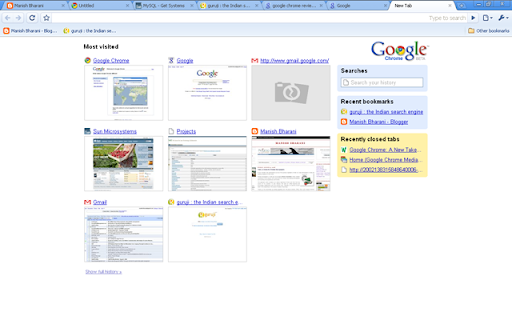
  • Browser has a combined search and address bar. Browser starts suggesting possible addresses as user starts entering web links or search strings.
  • Each new tab that opens on the browser provides a snapshot of most visited sites, book marks and recent searches.
  • User can search the browsing history instead of looking for it in the drop-down list. Also, users can use incognito window for private browsing where no browsing history is registered.
  • The tabs on the parent browser window can be pulled in and out to form separate windows or tab groups.
  • Each browser tab works as an independent process which means that if a site crashes on one tab, it would leave rest of the tabs intact while bringing down the tab on which a site crashed !!
  • The browser has softness of Apple's Safari and a punch on Mozilla's Firefox. It can  inherits the configuration from the installed browser.

  chrome_newtab

Here is some more info of interest ....

  • Its an open source browser !
  • It uses components from Apple's WebKit and Mozilla's Firefox.
  • Beta released is for windows, Mac and Linux versions would gradually follow
  • Its build over V8, a more powerful java script engine!

With a simple yet winning look and feel, its a browser that you would certainly like to try and decide like other Google products.

Google Chrome can be downloaded here

Sphere: Related Content

Sunday, August 31, 2008

Web 2.0 Style for Printed Newspapers

If you consider user participation as one of the primary ingredient of Web 2.0, Daily Newspapers in India are making a beeline on that route.  web2.0_News

Printed newspapers in India are encouraging Citizen Journalism where readers  contribute to the columns with social and civic issues, eye-opening photography and touching true experiences and stories.

The approach works wonders as it allows reporting of news right from the true source of its creation. It also reduces the load on official reporters and encourages collaboration with the common man. Typically, 5-10 percent of print seem to be originating in the hands of readers these days.

Thanks to the technology as people equipped with cell phone cameras, SMSs, PDAs with wireless Internet and mobile computing are able to catch the action live and report it on proper channel within no time.

Here are some of the interesting examples from a reputed Indian Daily ...

READER REPORTER : Crumbling Bangalore Roads

SOUL CURRY 

CITY MAILBOX

Sphere: Related Content

Monday, May 26, 2008

What makes Open Source Communities Thrive


Today I attended a session by David Axmark - Co-founder of MySQL, one of the most popular enterprise level database which was recently bought over by SUN and has been open sourced.

The session was one of the general information session which covered, high level design, road map, community development etc about MySQL. David strongly advocated "open source" strategy for his database technology. I liked his thoughts about open-sourcing and here are some of the take aways ...

Faster Turn around for product defects : Bugs reported on the propritory software take ages to resolve (most of the times). Bugs once reported get into vendors tracking database and most of the times user does not have a mechanism to see the status and contact the designer working on it. On the contrary, bugs filed against open source software are open source as well. Community can see the bugs and anyone is free to pick up the bugs and drive them to resolution. In most of the cases, this is fast, transparent and robust

Faster time to market : Contributions to open source is not bound to any release cycle or does not result out of any market forecasts. Community developers often use the open source code base to add on value added features and support as and when it appears relevant to them. In the bargain, as the community gets active around the product, product gets feature rich exponentially. To cite an example, SQL Server supports almost all languages including the recent once like ruby etc.

Quality Aspects : Open Source products are built under strict community vigilance. 100 balls are watching every moment to any changes being done. This adds quality to the contributed source that finally makes it to the production.

On being asked about what does it take to build a successful open source community like MySQL, he said ....

A. The product must address the real problem for which people still struggle to have a good solution.

B. Resort to short but relevant and quick product updates. Typically , come up with releases that have one big increment and hundreds of small but relevant updates to start with.

C. Complement the offerings with good documentation and easily accessible binary downloads so that the product can be quickly accessed, configured and used. Its a good idea to maintain a 15 or 20 min time threshold to what user would need to get started with the product. Complex configurations and heavy installations are deterrents to early inceptions to some otherwise great products.
Sphere: Related Content

Sunday, March 30, 2008

MDM Summit Demo: Some Learnings and a Great Team Work ....


Still seas do not make skillful sailors ... that was the message emanating from the Gir conference room at India Engg. Center of SUN Microsystems on the evening of 27th Feb 2008 as team Ahi was working full throttle on the MDM Summit Demo to be delivered around 8:00 PM to Monrovia team that evening.

Though the work had already begun couple of days before on the individual components for the demo, real impetus came in when the integration started with entire team getting involved. The stage was set, goals were clear and the eyes were focussed. The team got into a common room after a pint of wisdom from Ahi. All discussions came to a screeching halt and it was time to execute and build the bones together.

What appeared to be a sprint started taking the shape of a marathon when the team was unable to find a stable Netbeans installer to use for the integration. Version that was used for trial integration was phased out from the build machine. Local copies were also lost. We all groped for an Installer for close to six hours before we got something that looked promising !

Learning #1: Archive the best working software pieces that are used in the integration dry run. You never know when you would need it.

By the time things started getting into the shape at Bangalore, team at Monrovia started coming in and waited for a while before we could send instructions and software to proceed.

Learning #2: Work in a parallel mode with geographically distributed teams. Anticipate latency when huge pieces of software components need to be moved over the web.

As we chugged our way to the dawn, we started facing unusual software issues that required quick fixes and patches. Problems started creeping in when we unplugged the test data that we were working with till then and started using rich data sets created specifically for the demo scenario. The data created had been laying unattended for hours while other minor engg. issues were being fixed at mid-night.

Learning #3: Do early integration (as early as possible) and save time and last minute surprises.

After wresting with issues till 11:00 AM next morning with only occasional forty winks on the respective office chairs, the team started wrapping up gradually. The final bugle was blown at about 3:00 PM and that was when Ahi and Nilesh left the cockpit and ensured safe landing with a successful demo. Srini, went last, ensuring that what we delivered worked fine !

Thats the smile of contentment that keeps the life going .. despite all odds. Part of the game .. eh!


Sphere: Related Content

Saturday, March 8, 2008

Using SUN Master Index at Research Labs


This came to me like a real use case while discussing Project Mural offerings with a delegate from Govt. Of India Research Labs during SUN Tech Days at Hyderabad.

His Lab deals with data on protein samples that they work on. The various lab functions are geographically distributed and each of them generate similar data on the protein samples that need consolidation at a central point. It often happens that the data shipped in for the consolidation has subtle differences in the way its reported. Generating Master Index out of data with mismatch in complex protein names and associated parameters is a nightmare and it takes lots of manual effort in narrowing down human errors and creating a single view of the data in the central data pool. The volume of data generated is huge and the shipping format is a simple delimited flat file.

To me the problem looks like a simple use-case where SUN MDM solution can create a difference. Master Index Studio application in the Project Mural suite is equipped to deal with volume of similar data and can spin out Master Index of Related data sets. The application facilitates matching, de-duplication, merging, and cleansing of data from various data sources and performs probabilistic matching on the fields in the data records. MIDM (Master Index Data Manager) spices up the offering by providing the web application interface to the Master Index data and allows the user to have better control over the data being indexed.

More of SUN Master Index Studio Application can be found at :
The SUN MDM solution also contains :
Sphere: Related Content